The 1 Hook That's Working Best Right Now (And Why Your AI Will Never Get It Right)
While your LLM is busy cranking out high-intensity headlines, the rest of the world is pivoting toward something much calmer. This guide will show you which hooks actually scale in an exhausted market, and how to build them yourself.
Have you noticed how much "softer" organic content there is these days? 🤔 Trends like:
Poetcore (The "Analog Office" aesthetic)
Librarian Chic (Intellectual slow living)
Coastal Nothingness (The art of doing zero)
The Tradwife Evolution (Domestic "softness")
...are on a massive rise. We're seeing a ton of slow-living content going viral lately (and I can't stop watching it. 😅)
According to 2026 social data, over 50% of Americans are intentionally chasing at least some analog habits in their day to escape digital burnout. Gen Z, one of the most "online" generations, is leading the charge, with 63% actively seeking content that helps them disconnect.
Don't get me wrong: sometimes high-energy content still goes viral. But those videos get old fast. Meanwhile, "underconsumption-core" and soft-living clips are seeing 3x the engagement of traditional high-octane hauls.
There's a real psychological reason why top organic creators are defaulting to this trend, but it's not what you think.
This post outlines the slow-living movement, why it matters for performance marketers, and how to use it to write hooks that connect with an audience that is — quite frankly — exhausted.👋
By the end, you'll understand three things:
The Emotional Zone Audit: What this is and how to use it to grade your hooks before you spend a single dollar testing them.
The Headspace Rule: Why your customer's mood the second she sees your ad matters more than your creative, your targeting, or even your offer.
The Power of the Inside Voice: How to build calm, quiet creative that actually converts — and why 'soft' consistently outperforms loud.
Time to read: ~8 minutes.
Ready? Let's get into it.
Part 1: The Emotional Zone Audit
Before we go anywhere, I need to explain one critical concept, because it's the foundation for where we're going next.
"Creative is the new targeting" is common wisdom at this point. And yes, you need to target a specific emotion. But targeting any old emotion means nothing unless you understand how to communicate it.
In scientific terms, emotional communication is made of 2 separate parts: Valence and Intensity.
Think of these elements like the radio in your car:
Valence = the channel you're tuned to.
Valence tells you whether an emotion is "good" or "bad," positive or negative.
Positive Valence: Like a song you love. It feels good. (This is where emotions like joy, relief, calm, pride, and confidence live.)
Negative Valence: Like static or a song you hate. It feels bad. (Emotions like fear, anger, sadness, panic, and anxiety live here.)
Intensity = the volume you're set to.
Intensity tells you how loud that emotion is in the concept you're communicating.
High Intensity: The volume is all the way up. You can't ignore it. (Like panic or screaming for joy.)
Low Intensity: Just background noise. (Just a little frustration, or a quiet sense of peace.)
How to map these in your ads
Instead of a simple 1–10 NPS scale (which might capture intensity but won't tell you the full emotional picture), we put Valence and Intensity on a grid. This gives us four zones of human emotion — and where your hook lands on that grid tells you exactly how your customer is feeling when she encounters it.
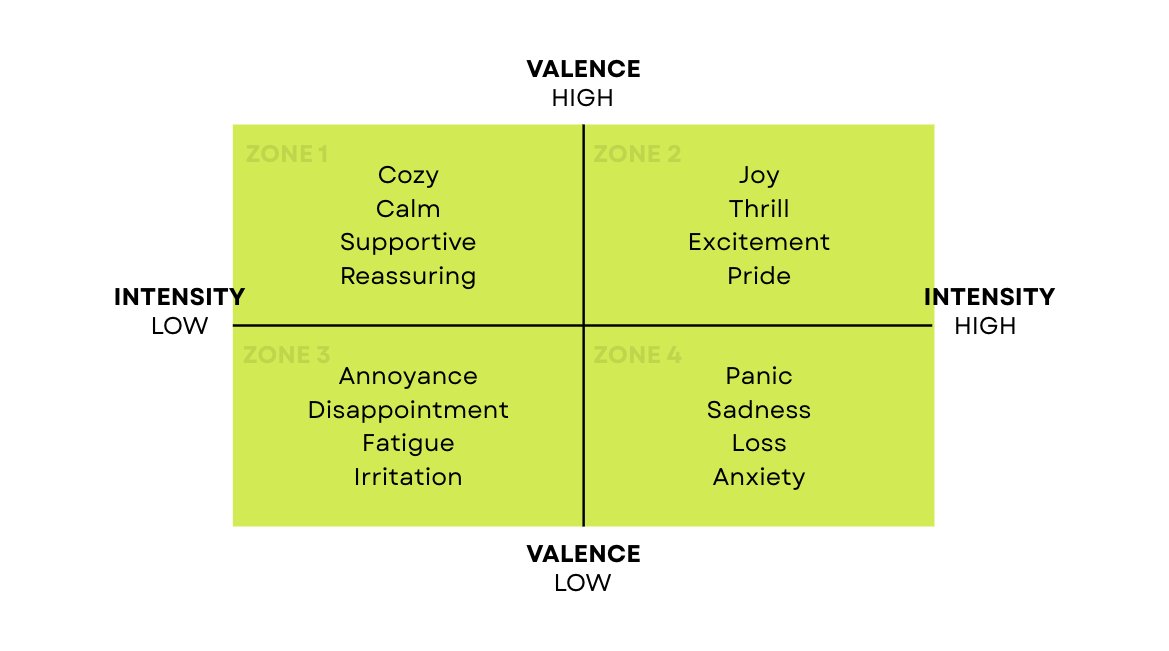
Zone 1 (Positive + Low Intensity): The 'Soft' Zone. Calm and reassuring.
Zone 2 (Positive + High Intensity): The 'Hype' Zone. Pure excitement.
Zone 3 (Negative + Low Intensity): The 'Bummer' Zone. Mild disappointment, annoyance, or overwhelm.
Zone 4 (Negative + High Intensity): The 'Panic' Zone. High-stakes and scary.
A huge amount of DTC creative lives in Zone 4. Big stakes. Worst-case scenarios. Fear-forward hooks. And if you're running an ad account right now, you've probably used at least one of those zones this week.
Here's the problem with that:
Zone 4 is not your friend — at least not up front.
I recently audited an ad account for a friend whose performance had been all over the place. The losing hooks almost always opened with a pretty common line:
"Are you exhausted from doing X?"
High intensity. Low valence. Zone 4, right out of the gate.
Before the viewer had decided whether to trust this brand, she'd already been handed the exact feeling she came to social media to escape.
Their performance issues had nothing to do with the creative format, the creator, or the offer. They had a communication issue. The hook was ambushing people instead of inviting them in.
The point here is that these "urgent" hooks we always use (Zone 4 hooks) can work sometimes, but only after trust is established. When you open cold with panic or maximum urgency, you're not compelling anyone. You're just making them scroll faster.
The winning hook for this brand was actually something entirely different: Zone 1.
"You don't have to keep doing this forever."
Calm. Supportive. Low intensity. High valence. No drama. No stakes. No pressure. Just: you have an out if you want one.
🚨That one shift helped them cut CAC from $180 to just under $60.
Part 2: The Headspace Rule
So why do Valence and Intensity zones matter so much? Because the hook doesn't exist in a vacuum, it shows up in a moment.
She's on her phone. She's on a 90-second break. She is not in problem-solving mode. She's in decompression mode.
Your ad isn't competing with other ads. It's competing with the mental state she was already in when the ad appeared. And if your hook demands she feel something she wasn't already feeling (especially something high-stakes or anxiety-inducing) she'll scroll before she's even conscious of why.
This is the Headspace Rule: your customer's emotional state at the moment of exposure matters more than anything else in your creative.
Not your offer.
Not your hook's cleverness.
Not your production value.
If your creative is mismatched with her headspace, none of the rest of it matters.
So ask yourself: if she were sitting across from me at a coffee shop right now, would I open the conversation this way? If you'd feel like you were ambushing her, rewrite the hook. The ad is the same context as the coffee shop. She's still a human being having a day.
The brands that understand this best don't try to interrupt her headspace. They meet her there so they can figure it out together.
Part 3: The Power of the Inside Voice
Once you understand Zones and Headspace, a specific type of hook becomes the obvious winner, and it's a very powerful one.
Zone 1 permission hooks.
These hooks use openers like:
"You don't have to..."
"You're allowed to stop..."
"Nobody told you, but there's actually a kinder way to..."
When you open with language like this, you're not just being gentle. You're doing something very specific to the brain.
A Zone 1 hook signals two things simultaneously:
1. This information is for everyone, and whoever's making this has no agenda. The viewer can trust what they say because they're not immediately trying to sell anything.
2. Someone is giving me permission to stop doing something hard. It borrows the authority of a neutral third party. It reminds the brain of when a teacher, a parent, or a trusted mentor told you it was okay to rest. That's not a small thing.
Permission hooks work the opposite way from most performance marketing. Instead of trying to activate your customer — triggering her into an emotional state you think is motivating — they release her from expectation. They give the brain something it wasn't prepared for: relief.
And relief, on a cold audience, converts remarkably well.
This is especially true for millennial and older female audiences:
For women aged 35–55, permission isn't just a tone of voice — it's one of the most powerful psychological levers available. Many of these women were raised in environments where someone else made the decisions. That conditioning doesn't disappear in adulthood. It shows up in how they respond to messaging.
For women aged 55–75, permission is a radical act of respect which is critical for this audience to experience before they'll buy. This demographic has spent decades being the primary target of 'fix-it' marketing and high-pressure societal 'shoulds.' They've developed world-class radar for being handled, and a deep exhaustion with expert noise.
When a credentialed authority (a doctor, a scientist, a kind friend) says you don't have to do this anymore, that message lands at a subconscious level that "GET IT BEFORE IT'S TOO LATE" simply cannot reach.
Not because it's more true, but because of who gets to grant permission in our culture.
Meeting your customer in her actual psychological reality instead of the idealized version marketers prefer to imagine is the only way to get these kinds of results.
But there's something you should know before you go creating them...
What kills this format before it starts
There are 4 habits I see markters default to when they try to create these types of hooks, ones you'll definitely want to avoid:
Contrast language too early. "Most people do X, but you should do Y" is the first and honestly, most irritating way to break a good permission hook. "Don't do X, do Y" reads as preachy before trust exists. Save it for the middle of your ad.
Victim framing. "You've been lied to" occasionally works with audiences that have already consumed much of your content (
), but it positions your customer as helpless before she's opted in. Use it carefully.
Hedging your bets. "This might not be for everyone, but..." causes so much eye-rolling with customers, it's not even funny. Uncertainty in the hook signals uncertainty in the product, so avoid this when possible.
The fakeout. If the hook says Zone 1 but the rest of the ad feels like Zone 4 pressure, your customer will clock the dissonance...even if she can't name it. The zone has to hold all the way through. Not just in the first line.
Avoid these four, and you'll be further ahead than 90% of the creative strategists in this industry.
How to Write Permission-Based Hooks
Here's the exact process I use to draft these from scratch. Let's build one live, for a clean hair color brand targeting women who've been dyeing their hair for years but are ready to stop using chemicals.
Step 1: Start with the obligation.
Open a doc and finish this sentence without overthinking it:
"My customer has been white-knuckling _______ for way too long."
Write 5–10 versions. Don't edit yet. You're excavating the exhaustion she's already carrying before she ever sees your ad.
For our hair dye customer, here's what comes up:
She’s been white-knuckling the salon appointment. She books it, tells herself this is the last time, and goes anyway.
She’s been white-knuckling the smell. The burning on her scalp. The way she has to hold her breath the whole time and tell herself it’s fine...even though she knows the damage she's doing.
She’s been white-knuckling the ingredient list she looked up once and immediately closed.
She’s been white-knuckling the belief that going gray means giving up. On her appearance, on how people see her, on some version of herself she’s not ready to let go of yet.
She’s been white-knuckling the choice itself.
Next, take your list and move to step 2:
Step 2: Convert it to a release.
Take your best answer from Step 1 and rewrite it as a permission statement:
"You don't have to [keep doing the hard thing] anymore."
"You're allowed to stop [painful cycle]."
"Nobody told you, but there's actually a kinder way to [thing she's been forcing]."
Read it out loud. Does it feel Zone 1? If it sounds urgent, scary, or like it's trying to sell something, soften it until it sounds like advice from a calm, trusted friend.
For our customer:
First attempt: “You don’t have to keep putting chemicals on your head just to feel like yourself.”
That’s close, but “putting chemicals on your head” might read as slightly accusatory on a cold audience, like you’re already implying she’s been doing something wrong. Soften it:
“You’re allowed to want your color and your health. You don’t have to choose.”
That’s Zone 1. Calm. No blame. Just a quiet acknowledgment that she’s been told these two things are in conflict, and they don’t have to be.
Step 3: Find the micro-moment.
Ask yourself: when is the exact moment she feels this most acutely? Not the broad problem — the specific, lived micro-moment.
Then drop all three (the obligation, the release, and this prompt) into Claude and ask:
'Describe the last time my customer felt [the exhaustion/frustration/stuck feeling] in a really specific, visual way. What was she doing? What environment was she in? What did she think? What did she not say out loud?"
Write 3–5 micro-moments. Pick the one that makes you think: yeah, she's definitely thought this exact thing. That's your Part 2 line.
For our customer, the micro-moment that lands:
She’s sitting in the salon chair with the cape around her shoulders, and the smell hits her before the colorist even opens the bowl. She knows that smell. She’s been breathing it for twenty years. She pulls out her phone so she has somewhere to look. She doesn’t say anything. She just sits there and waits for it to be over.
That is the moment. Not “I’m worried about chemicals.” Just: the smell. The cape. The waiting.
Part 2 line: ‘She just sits there and waits for it to be over.’
Step 4: Draft the bridge.
Decide: would this work better as a voiceover or first-person POV? That determines your bridge:
Voiceover: '...so what am I actually supposed to do?' → expert steps in.
First-person: 'Here's what I found.' / 'Let me show you.'
Keep it simple. The loop just needs to point forward without resolving anything yet.
For our customer, voiceover works well here. It lets a warm, credentialed voice (a clean beauty formulator, a functional medicine doctor, or a woman who made the switch herself) step in naturally.
Bridge: ‘I didn’t want to stop coloring. I just didn’t want to keep doing it like this. What should I do?"
Step 5: Run the Zone Audit.
Before you put this ad into production, read the full hook out loud and check:
Does the opening land in Zone 1 (calm, positive, low intensity)?
Does the micro-moment make her feel seen, not guilty?
Does the open loop create curiosity without pressure?
Three yeses = ready to test. If anything is creeping toward Zone 4 (urgency, consequence, fear), go back and soften it.
The full hook, assembled:
Voiceover: “You’re allowed to want your color and your health. You don’t have to choose."
(Show the salon chair. The cape. The smell that hits before anything else. She just sits there and waits for it to be over.)
Voiceover: "I didn’t want to stop coloring. I just didn’t want to keep doing it like this. What should I do?"
No drama. No “you’ve been poisoning yourself for years.” No fear-forward before-and-after. Just a moment she knows by heart, a quiet acknowledgment that wanting both things is valid, and an open loop that makes the next frame — the product, the formulator, the cleaner way — feel like a relief instead of a pitch.
Zone 1 open. Zone 3 micro-moment (she feels seen, not accused). Bridge points forward without pressure. Coherent arc. Ready to test.
A Note on AI and Why It Gets This Wrong Every Time
AI learned to write from the internet. And the internet loves drama.
It makes the subconscious conscious too fast. It over-explains motivation. It defaults to Zone 4 when Zone 1 or Zone 3 would actually convert because dramatic reads as compelling to a model trained on engagement, not on purchase.
Your customer's actual lived experience is much, much quieter than what AI generates. More mundane. She doesn't always wake up thinking "I am exhausted and anxious and I need a solution NOW." She just notices something feels a little off, and moves on with her day.
The best creative meets her in that moment. Not in the fully-articulated, high-stakes version of her pain that AI generates because it pulled from a thousand blog posts about her demographic.
This is why creative strategy is still a human job.
You've been in that moment. You know what it actually feels like. AI doesn't.
The 4-Question Hook Audit
Before you launch anything, run it through these four questions:
1. What zone does this hook open in? Map it on the grid. Zone 1 or Zone 3-to-Zone 1 for cold audiences, almost always. Zone 4 as an opener is burning budget on people who scroll because they didn't come to feel that way right now.
2. Who is she at the exact moment she sees this? She's on her phone. Ninety-second break. Decompression mode, not problem-solving mode. If you'd feel like you were ambushing her in a coffee shop, rewrite it.
3. What's she already telling herself? The best hooks don't introduce a new problem. They name one she's been carrying for a while. Read your hook out loud: would she nod, or would she frown? A nod means you named something real. A frown means you either got it wrong, or made her feel accused instead of understood.
4. Does the emotional arc resolve before the CTA? Map it. Where does it start? Where does it peak? Does it come back up before you ask for anything? The winning ad from the audit above opened Zone 1, dipped into Zone 3 to validate the problem, then resolved back to Zone 1 before the offer. Coherent arc. Earned click. A hook that opens in Zone 4 and never resolves is just a bad time from start to finish.
What to Test Next
Run Zone 1 and Zone 3 openers against each other. If your current hooks are Zone 4-heavy, you already know what to do. Test a calm permission opener ('you don't have to keep doing this') against a mild shared-frustration opener ('we all somehow decided this was just how it had to be...it's not'). Both will likely outperform the drama.
Test a two-voice structure. Female voice opens the hook → immediate identification (she's like me). Transition to a credentialed expert for the permission drop. End her part with 'what should I do?' — open loop, expert entry feels inevitable instead of promotional. This mirrors how women actually get recommendations: a friend names the problem and points you to the person who solved it.
Don't confuse intensity with persuasion. Zone 4 hooks feel exciting to build. They can convert well but often die out faster than the calm ones. I know that's annoying. It's still true. (Run the data before you trust your gut, your gut was trained by years of consuming high-intensity creative, not by conversion data. 🙏)
Go back to the micro-moments first. If hooks aren't working, the problem is almost never the hook itself. It's that you're working from a vague sense of your customer's emotional state instead of a specific, lived moment she'd actually recognize. Pull real quotes from reviews, Reddit threads, comment sections. Find the moment before the moment. That's where the best hooks live.
The reason direct response works (when it actually works) is that it meets people where they are. Not where you want them to be. Not where the drama is.
Where they actually are.
Your audience doesn't need to be pushed. She needs to feel like she found the answer herself.
That's the whole game. 👊
While your LLM is busy cranking out high-intensity headlines, the rest of the world is pivoting toward something much calmer. This guide will show you which hooks actually scale in an exhausted market, and how to build them yourself.
Have you noticed how much "softer" organic content there is these days? 🤔 Trends like:
Poetcore (The "Analog Office" aesthetic)
Librarian Chic (Intellectual slow living)
Coastal Nothingness (The art of doing zero)
The Tradwife Evolution (Domestic "softness")
...are on a massive rise. We're seeing a ton of slow-living content going viral lately (and I can't stop watching it. 😅)
According to 2026 social data, over 50% of Americans are intentionally chasing at least some analog habits in their day to escape digital burnout. Gen Z, one of the most "online" generations, is leading the charge, with 63% actively seeking content that helps them disconnect.
Don't get me wrong: sometimes high-energy content still goes viral. But those videos get old fast. Meanwhile, "underconsumption-core" and soft-living clips are seeing 3x the engagement of traditional high-octane hauls.
There's a real psychological reason why top organic creators are defaulting to this trend, but it's not what you think.
This post outlines the slow-living movement, why it matters for performance marketers, and how to use it to write hooks that connect with an audience that is — quite frankly — exhausted.👋
By the end, you'll understand three things:
The Emotional Zone Audit: What this is and how to use it to grade your hooks before you spend a single dollar testing them.
The Headspace Rule: Why your customer's mood the second she sees your ad matters more than your creative, your targeting, or even your offer.
The Power of the Inside Voice: How to build calm, quiet creative that actually converts — and why 'soft' consistently outperforms loud.
Time to read: ~8 minutes.
Ready? Let's get into it.
Part 1: The Emotional Zone Audit
Before we go anywhere, I need to explain one critical concept, because it's the foundation for where we're going next.
"Creative is the new targeting" is common wisdom at this point. And yes, you need to target a specific emotion. But targeting any old emotion means nothing unless you understand how to communicate it.
In scientific terms, emotional communication is made of 2 separate parts: Valence and Intensity.
Think of these elements like the radio in your car:
Valence = the channel you're tuned to.
Valence tells you whether an emotion is "good" or "bad," positive or negative.
Positive Valence: Like a song you love. It feels good. (This is where emotions like joy, relief, calm, pride, and confidence live.)
Negative Valence: Like static or a song you hate. It feels bad. (Emotions like fear, anger, sadness, panic, and anxiety live here.)
Intensity = the volume you're set to.
Intensity tells you how loud that emotion is in the concept you're communicating.
High Intensity: The volume is all the way up. You can't ignore it. (Like panic or screaming for joy.)
Low Intensity: Just background noise. (Just a little frustration, or a quiet sense of peace.)
How to map these in your ads
Instead of a simple 1–10 NPS scale (which might capture intensity but won't tell you the full emotional picture), we put Valence and Intensity on a grid. This gives us four zones of human emotion — and where your hook lands on that grid tells you exactly how your customer is feeling when she encounters it.
Zone 1 (Positive + Low Intensity): The 'Soft' Zone. Calm and reassuring.
Zone 2 (Positive + High Intensity): The 'Hype' Zone. Pure excitement.
Zone 3 (Negative + Low Intensity): The 'Bummer' Zone. Mild disappointment, annoyance, or overwhelm.
Zone 4 (Negative + High Intensity): The 'Panic' Zone. High-stakes and scary.
A huge amount of DTC creative lives in Zone 4. Big stakes. Worst-case scenarios. Fear-forward hooks. And if you're running an ad account right now, you've probably used at least one of those zones this week.
Here's the problem with that:
Zone 4 is not your friend — at least not up front.
I recently audited an ad account for a friend whose performance had been all over the place. The losing hooks almost always opened with a pretty common line:
"Are you exhausted from doing X?"
High intensity. Low valence. Zone 4, right out of the gate.
Before the viewer had decided whether to trust this brand, she'd already been handed the exact feeling she came to social media to escape.
Their performance issues had nothing to do with the creative format, the creator, or the offer. They had a communication issue. The hook was ambushing people instead of inviting them in.
The point here is that these "urgent" hooks we always use (Zone 4 hooks) can work sometimes, but only after trust is established. When you open cold with panic or maximum urgency, you're not compelling anyone. You're just making them scroll faster.
The winning hook for this brand was actually something entirely different: Zone 1.
"You don't have to keep doing this forever."
Calm. Supportive. Low intensity. High valence. No drama. No stakes. No pressure. Just: you have an out if you want one.
🚨That one shift helped them cut CAC from $180 to just under $60.
Part 2: The Headspace Rule
So why do Valence and Intensity zones matter so much? Because the hook doesn't exist in a vacuum, it shows up in a moment.
She's on her phone. She's on a 90-second break. She is not in problem-solving mode. She's in decompression mode.
Your ad isn't competing with other ads. It's competing with the mental state she was already in when the ad appeared. And if your hook demands she feel something she wasn't already feeling (especially something high-stakes or anxiety-inducing) she'll scroll before she's even conscious of why.
This is the Headspace Rule: your customer's emotional state at the moment of exposure matters more than anything else in your creative.
Not your offer.
Not your hook's cleverness.
Not your production value.
If your creative is mismatched with her headspace, none of the rest of it matters.
So ask yourself: if she were sitting across from me at a coffee shop right now, would I open the conversation this way? If you'd feel like you were ambushing her, rewrite the hook. The ad is the same context as the coffee shop. She's still a human being having a day.
The brands that understand this best don't try to interrupt her headspace. They meet her there so they can figure it out together.
Part 3: The Power of the Inside Voice
Once you understand Zones and Headspace, a specific type of hook becomes the obvious winner, and it's a very powerful one.
Zone 1 permission hooks.
These hooks use openers like:
"You don't have to..."
"You're allowed to stop..."
"Nobody told you, but there's actually a kinder way to..."
When you open with language like this, you're not just being gentle. You're doing something very specific to the brain.
A Zone 1 hook signals two things simultaneously:
1. This information is for everyone, and whoever's making this has no agenda. The viewer can trust what they say because they're not immediately trying to sell anything.
2. Someone is giving me permission to stop doing something hard. It borrows the authority of a neutral third party. It reminds the brain of when a teacher, a parent, or a trusted mentor told you it was okay to rest. That's not a small thing.
Permission hooks work the opposite way from most performance marketing. Instead of trying to activate your customer — triggering her into an emotional state you think is motivating — they release her from expectation. They give the brain something it wasn't prepared for: relief.
And relief, on a cold audience, converts remarkably well.
This is especially true for millennial and older female audiences:
For women aged 35–55, permission isn't just a tone of voice — it's one of the most powerful psychological levers available. Many of these women were raised in environments where someone else made the decisions. That conditioning doesn't disappear in adulthood. It shows up in how they respond to messaging.
For women aged 55–75, permission is a radical act of respect which is critical for this audience to experience before they'll buy. This demographic has spent decades being the primary target of 'fix-it' marketing and high-pressure societal 'shoulds.' They've developed world-class radar for being handled, and a deep exhaustion with expert noise.
When a credentialed authority (a doctor, a scientist, a kind friend) says you don't have to do this anymore, that message lands at a subconscious level that "GET IT BEFORE IT'S TOO LATE" simply cannot reach.
Not because it's more true, but because of who gets to grant permission in our culture.
Meeting your customer in her actual psychological reality instead of the idealized version marketers prefer to imagine is the only way to get these kinds of results.
But there's something you should know before you go creating them...
What kills this format before it starts
There are 4 habits I see markters default to when they try to create these types of hooks, ones you'll definitely want to avoid:
Contrast language too early. "Most people do X, but you should do Y" is the first and honestly, most irritating way to break a good permission hook. "Don't do X, do Y" reads as preachy before trust exists. Save it for the middle of your ad.
Victim framing. "You've been lied to" occasionally works with audiences that have already consumed much of your content (
), but it positions your customer as helpless before she's opted in. Use it carefully.
Hedging your bets. "This might not be for everyone, but..." causes so much eye-rolling with customers, it's not even funny. Uncertainty in the hook signals uncertainty in the product, so avoid this when possible.
The fakeout. If the hook says Zone 1 but the rest of the ad feels like Zone 4 pressure, your customer will clock the dissonance...even if she can't name it. The zone has to hold all the way through. Not just in the first line.
Avoid these four, and you'll be further ahead than 90% of the creative strategists in this industry.
How to Write Permission-Based Hooks
Here's the exact process I use to draft these from scratch. Let's build one live, for a clean hair color brand targeting women who've been dyeing their hair for years but are ready to stop using chemicals.
Step 1: Start with the obligation.
Open a doc and finish this sentence without overthinking it:
"My customer has been white-knuckling _______ for way too long."
Write 5–10 versions. Don't edit yet. You're excavating the exhaustion she's already carrying before she ever sees your ad.
For our hair dye customer, here's what comes up:
She’s been white-knuckling the salon appointment. She books it, tells herself this is the last time, and goes anyway.
She’s been white-knuckling the smell. The burning on her scalp. The way she has to hold her breath the whole time and tell herself it’s fine...even though she knows the damage she's doing.
She’s been white-knuckling the ingredient list she looked up once and immediately closed.
She’s been white-knuckling the belief that going gray means giving up. On her appearance, on how people see her, on some version of herself she’s not ready to let go of yet.
She’s been white-knuckling the choice itself.
Next, take your list and move to step 2:
Step 2: Convert it to a release.
Take your best answer from Step 1 and rewrite it as a permission statement:
"You don't have to [keep doing the hard thing] anymore."
"You're allowed to stop [painful cycle]."
"Nobody told you, but there's actually a kinder way to [thing she's been forcing]."
Read it out loud. Does it feel Zone 1? If it sounds urgent, scary, or like it's trying to sell something, soften it until it sounds like advice from a calm, trusted friend.
For our customer:
First attempt: “You don’t have to keep putting chemicals on your head just to feel like yourself.”
That’s close, but “putting chemicals on your head” might read as slightly accusatory on a cold audience, like you’re already implying she’s been doing something wrong. Soften it:
“You’re allowed to want your color and your health. You don’t have to choose.”
That’s Zone 1. Calm. No blame. Just a quiet acknowledgment that she’s been told these two things are in conflict, and they don’t have to be.
Step 3: Find the micro-moment.
Ask yourself: when is the exact moment she feels this most acutely? Not the broad problem — the specific, lived micro-moment.
Then drop all three (the obligation, the release, and this prompt) into Claude and ask:
'Describe the last time my customer felt [the exhaustion/frustration/stuck feeling] in a really specific, visual way. What was she doing? What environment was she in? What did she think? What did she not say out loud?"
Write 3–5 micro-moments. Pick the one that makes you think: yeah, she's definitely thought this exact thing. That's your Part 2 line.
For our customer, the micro-moment that lands:
She’s sitting in the salon chair with the cape around her shoulders, and the smell hits her before the colorist even opens the bowl. She knows that smell. She’s been breathing it for twenty years. She pulls out her phone so she has somewhere to look. She doesn’t say anything. She just sits there and waits for it to be over.
That is the moment. Not “I’m worried about chemicals.” Just: the smell. The cape. The waiting.
Part 2 line: ‘She just sits there and waits for it to be over.’
Step 4: Draft the bridge.
Decide: would this work better as a voiceover or first-person POV? That determines your bridge:
Voiceover: '...so what am I actually supposed to do?' → expert steps in.
First-person: 'Here's what I found.' / 'Let me show you.'
Keep it simple. The loop just needs to point forward without resolving anything yet.
For our customer, voiceover works well here. It lets a warm, credentialed voice (a clean beauty formulator, a functional medicine doctor, or a woman who made the switch herself) step in naturally.
Bridge: ‘I didn’t want to stop coloring. I just didn’t want to keep doing it like this. What should I do?"
Step 5: Run the Zone Audit.
Before you put this ad into production, read the full hook out loud and check:
Does the opening land in Zone 1 (calm, positive, low intensity)?
Does the micro-moment make her feel seen, not guilty?
Does the open loop create curiosity without pressure?
Three yeses = ready to test. If anything is creeping toward Zone 4 (urgency, consequence, fear), go back and soften it.
The full hook, assembled:
Voiceover: “You’re allowed to want your color and your health. You don’t have to choose."
(Show the salon chair. The cape. The smell that hits before anything else. She just sits there and waits for it to be over.)
Voiceover: "I didn’t want to stop coloring. I just didn’t want to keep doing it like this. What should I do?"
No drama. No “you’ve been poisoning yourself for years.” No fear-forward before-and-after. Just a moment she knows by heart, a quiet acknowledgment that wanting both things is valid, and an open loop that makes the next frame — the product, the formulator, the cleaner way — feel like a relief instead of a pitch.
Zone 1 open. Zone 3 micro-moment (she feels seen, not accused). Bridge points forward without pressure. Coherent arc. Ready to test.
A Note on AI and Why It Gets This Wrong Every Time
AI learned to write from the internet. And the internet loves drama.
It makes the subconscious conscious too fast. It over-explains motivation. It defaults to Zone 4 when Zone 1 or Zone 3 would actually convert because dramatic reads as compelling to a model trained on engagement, not on purchase.
Your customer's actual lived experience is much, much quieter than what AI generates. More mundane. She doesn't always wake up thinking "I am exhausted and anxious and I need a solution NOW." She just notices something feels a little off, and moves on with her day.
The best creative meets her in that moment. Not in the fully-articulated, high-stakes version of her pain that AI generates because it pulled from a thousand blog posts about her demographic.
This is why creative strategy is still a human job.
You've been in that moment. You know what it actually feels like. AI doesn't.
The 4-Question Hook Audit
Before you launch anything, run it through these four questions:
1. What zone does this hook open in? Map it on the grid. Zone 1 or Zone 3-to-Zone 1 for cold audiences, almost always. Zone 4 as an opener is burning budget on people who scroll because they didn't come to feel that way right now.
2. Who is she at the exact moment she sees this? She's on her phone. Ninety-second break. Decompression mode, not problem-solving mode. If you'd feel like you were ambushing her in a coffee shop, rewrite it.
3. What's she already telling herself? The best hooks don't introduce a new problem. They name one she's been carrying for a while. Read your hook out loud: would she nod, or would she frown? A nod means you named something real. A frown means you either got it wrong, or made her feel accused instead of understood.
4. Does the emotional arc resolve before the CTA? Map it. Where does it start? Where does it peak? Does it come back up before you ask for anything? The winning ad from the audit above opened Zone 1, dipped into Zone 3 to validate the problem, then resolved back to Zone 1 before the offer. Coherent arc. Earned click. A hook that opens in Zone 4 and never resolves is just a bad time from start to finish.
What to Test Next
Run Zone 1 and Zone 3 openers against each other. If your current hooks are Zone 4-heavy, you already know what to do. Test a calm permission opener ('you don't have to keep doing this') against a mild shared-frustration opener ('we all somehow decided this was just how it had to be...it's not'). Both will likely outperform the drama.
Test a two-voice structure. Female voice opens the hook → immediate identification (she's like me). Transition to a credentialed expert for the permission drop. End her part with 'what should I do?' — open loop, expert entry feels inevitable instead of promotional. This mirrors how women actually get recommendations: a friend names the problem and points you to the person who solved it.
Don't confuse intensity with persuasion. Zone 4 hooks feel exciting to build. They can convert well but often die out faster than the calm ones. I know that's annoying. It's still true. (Run the data before you trust your gut, your gut was trained by years of consuming high-intensity creative, not by conversion data. 🙏)
Go back to the micro-moments first. If hooks aren't working, the problem is almost never the hook itself. It's that you're working from a vague sense of your customer's emotional state instead of a specific, lived moment she'd actually recognize. Pull real quotes from reviews, Reddit threads, comment sections. Find the moment before the moment. That's where the best hooks live.
The reason direct response works (when it actually works) is that it meets people where they are. Not where you want them to be. Not where the drama is.
Where they actually are.
Your audience doesn't need to be pushed. She needs to feel like she found the answer herself.
That's the whole game. 👊