Operational Efficiency is a Strategic Choice: How the best Creative Strategists Scale Without Volume
There's a particularly insidious form of dogma happening in performance marketing right now, and it goes something like this: a creative strategist walks into a Monday morning standup, presents last week's metrics (complete with rising CPAs, stagnant hooks, and stagnant growth. Nothing catastrophic but nothing inspiring either...)
Before they can finish explaining the nuance of what they're seeing in the data, someone from leadership interjects:
"We just need to run more ads. Our goal for this week is to launch 100 more, better get started..."
The creative strategist leaves, deflated, more burnt out than they came in, and heads right to their computer to get started on updating their resume...
This is an all too common scenario in DTC, and it's not just burning out your strategists and your production teams and your already-strained ad budget. It's actively making your advertising worse, because high volume without psychological variance isn't a strategy at all. It's just expensive wallpaper that your audience has learned to ignore with the same practiced efficiency they use to skip YouTube pre-rolls and scroll past sponsored posts from brands they've never heard of and will never remember.
But here's what makes this moment particularly interesting: we're starting to see hard data that proves what the best creative strategists have been arguing for years, which is:
You can actually scale harder by producing less.
And I'm not talking about some theoretical framework that sounds good in a conference room but falls apart when it meets your actual ad account. I'm talking about real brands, right now, cutting creative volume by 50% or more and simultaneously increasing spend, increasing efficiency, and increasing revenue.
Sounds impossible until you understand that the problem was never volume in the first place...
Let me show you what I mean.
Nate Lagos, who runs growth for one of the faster-scaling DTC brands in the supplement space, posted this case study recently:
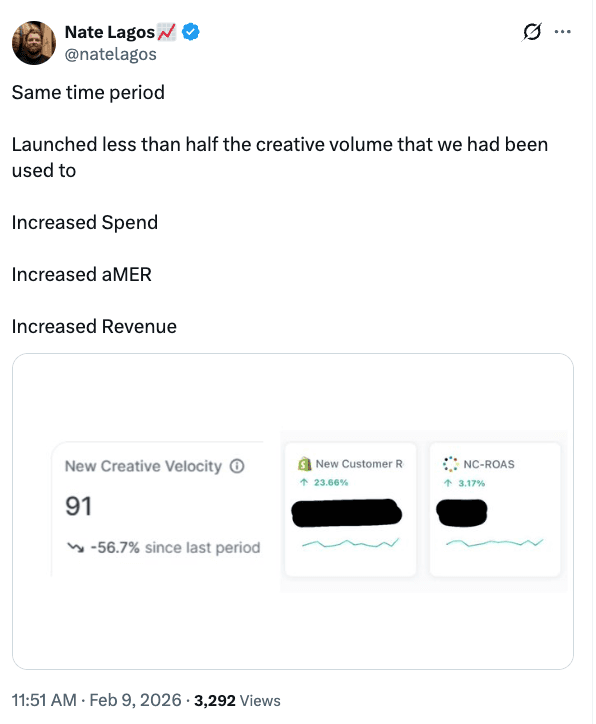
Same time period, launched less than half the creative volume they'd been running, and the result was increased spend, increased aMER, increased revenue, with new creative velocity down 56.7% compared to the previous period.
I know Nate, and this is not an anomaly for him. He's mastered the precision game so well, he's been able to duplicate these kind of results for multiple brands within the same period...simply by refusing to believe the "volume is the way" hype.
That's what happens when you stop treating creative production like a numbers game and start treating it like a strategic mapping exercise where the goal isn't to make more ads, but to systematically cover different psychological territories your customer exists in until you find the ones that actually move human behavior.
The "Empty Volume" Crisis: Why More Ads Doesn't Mean More Growth
If you need another reason to believe volume isn't the way, I've got more for you:
Meta's algorithm, as of 2026, has fundamentally shifted how it evaluates creative diversity, and the performance marketing industry is still catching up to what this actually means for how we build and test ads.
In late 2024, Meta introduced a completely new algorithm dubbed Andromeda, effectively replacing the old targeting systems advertisers relied on for years (source: Social Media Examiner).
The implications of this change are massive...but honestly not surprising. Andromeda:
Is 100x faster at matching people to ads
Can handle 10,000x more ad variants in parallel
Focuses on how your creative performs, not who it's targeting
(Source: Anchour) This sounds like great news until you realize that instead of focusing on "creative is the new targeting", Meta now wants you to create ads that mean something to your customer...not just target them. (Source: AdScale.)
Here's where it gets interesting for the "just launch more ads" crowd:
Meta is rolling out new metrics to help you identify when your entire creative stack needs an update, including a new metric (Creative Similarity) that will directly affect whether your ads get served.
If your Creative Similarity is high (meaning you lack psychological diversity), the Andromeda algorithm will punish your account by raising your CPMs because it views the content as repetitive and fatiguing.
AKA: if you take the same angle and just repackage it 100 different ways, be prepared to suffer the bank account consequences. (Source: Social Media Examiner.)
If you're launching ten ads that all live in the same psychological zone (different hooks, sure: maybe one starts with a question and another starts with a statistic and another starts with a bold claim, but all of them operating from the same emotional premise, the same identity anchor, the same intensity level) Meta will pick one of these ads, push all the spend towards that, and ignore the rest (source: Anchour)
If you're doing this, you're not testing ten separate concepts, you're testing one concept ten times, and that's not strategic diversification...that's just wasting your production budget on redundancy while the algorithm actively penalizes you for it.
The distinction that matters now is this:
Creative iteration (changing the hook) is not the same as creative variation (changing the concept. Source: Anchour).
The new Meta system doesn't care that you changed the B-roll or swapped out the testimonial or adjusted the color grade; Meta now rewards true variation: radically different angles, tones, and most importantaly...psychological archetypes (source: Anchour) and if you're not providing that, you're just creating ads...for funsies.
You're paying higher CPMs for the privilege of being ignored.
(There's a secondary metric you should also be watching: CPMr (Cost per 1,000 reach). A rising CPMr means you're paying to show the same ads to the same people, while a healthy CPMr means your creative is expanding your reach to new, qualified audiences (source: Anchour) and when your CPMr starts climbing, that's not a signal to increase your budget or tweak your targeting, that's your early warning system telling you that your creative has become psychologically redundant and the algorithm is making you pay for it.)
A great example of just how critical this is:
A good founder friend of mine sells smart thermostats. They had a strong product, solid brand perception, but as their founder put it: "There was no system. It was just finding ads where we could find them... it wasn't like a system or anything, it was ad hoc."
They were pulling ideas from Reddit, from Foreplay, from competitors, with no framework to translate customer emotion into creative direction, which meant they were essentially guessing their way through production and hoping something would stick.
They had a disconnected creative process, copycat competitor ideas, no insight into what actually worked, no repeatable system, inconsistent wins (the classic symptoms of the Volume problem where you're producing constantly but never building strategic knowledge, and worse, likely triggering Meta's Creative Similarity penalties without even realizing it.)
When they finally decided to stop running 100+ ads a month and implemented a psychological modeling approach instead of just cranking out more ads, 50% of their total ad spend naturally shifted toward the psychologically-informed ads (the ones built from actual emotional driver research rather than competitor surveillance).
Those ads consistently outperformed their legacy creative, and the founder and team started using the psychological framework 3-4 times per week as their creative starting point instead of the old "let's try this hook we saw somewhere" approach.
Most tellingly, ad concepts that used to take days or weeks to develop were suddenly being produced in hours.
When you know what psychological job the ad needs to do, you stop iterating blindly and start building with intent...and you stop triggering that Creative Similarity filter because you're building ads that are genuinely, psychologically distinct rather than just superficially different.
The Framework: The Three Dimensions of a Nutritionally Dense (Psychologically Distinct) Ad
Here's the point of this whole article:
Creative Strategists who scale quickly and easily have made the decision to stop measuring success by output (how many ads you shipped) and started measuring it by strategic coverage (how much of the psychological landscape you've actually mapped),
The whole freaking point of advertising isn't to flood the market with content (do that on your social media accounts) it's to systematically test the different ways a human brain can be moved from scroll, to stop, to click, to convert...and that requires a strategy, not a factory.
Instead of producing fifty variations of the same "Problem/Solution" structure (which, let's be honest, is what most brands do because it feels safe and formulaic and you can brief a freelancer on it in under three minutes) a genuinely effective Creative Strategist builds what I call a psychological matrix, and that matrix has three dimensions, each of which represents a fundamentally different axis of human response.
When you map your creative across these three dimensions instead of just iterating on surface-level variables like "what if we start with the product shot instead of the lifestyle shot," you create ads that aren't just different, they're strategically distinct in ways that both the algorithm and the human viewer can actually register as meaningfully separate experiences.
1️⃣ Dimension 1: The Valence Zone (The Emotional Charge)
This is the emotional charge of the ad, but this isn't about whether your ad is "happy" or "sad" in some vague, vibes-based way. To start building nutritionally dense ads, we need to decide what we want to activate neurologically. There are typically two states we want to focus on (usually mapped into 4 quadrants):
High Valence States can be either positive or negative. These emotions are highly volitile, somewhat fleeting and can show up across the customer journey. (See chart below.)
Low Valence States can also be positive or negative. These states tend to last a bit longer, but can show up across the journey as well. (See chart below.)

Most brands, if you actually audit their creative library, live almost exclusively in the High Valence/Negative (Zone 4) quadrant—the "Stop Scrolling" shock tactics, the fear-based urgency, the "You're doing it wrong and here's why" approach.
I get why: that's what performance marketing has conditioned us to believe works. But what these brands are missing is that High Valence ads are exhausting for the regular consumer.
No body wants to constantly be told they're doing something wrong, that they're behind others they seek approval from, or that time is slipping away from them...which is why these types of ads only resonate with a specific psychological segment of your audience (the people who are already in a heightened emotional state and ready to make a snap decision).
If you're only running ads in Zone 4, you're ignoring everyone who's in Zone 1, Zone 2 or Zone 3 right now (everyone who doesn't want to be shouted at but might be persuaded by something that feels like a gentle revelation rather than an alarm bell.)
I've seen brands completely transform their entire creative strategy overnight using this model (one brand saw a 35% increase in AOV, a 33% increase in LTV, and a 25% lift in revenue growth in just 6 weeks...just by running ads in different zones. 😅
It sounds too simple to be true, I know...
But the customer can tell when you're in it for the money, I promise you. Generating ads that cover a wider range of emotions means you won't need to bribe people to buy, you won't need to frantically over-create just to get the same results in your ad account, and you won't need to increase your ad budget next year just to get the same results.
If you're a creative strategist reading this, here's your strategic play here:
Don't test Hook A versus Hook B within the same valence zone.
Test a Positive Valence ad (aspiration, transformation, the life you could be living) against a Negative Valence ad (pain point avoidance, the problem you're currently suffering from) and see which emotional charge your audience is actually receptive to right now, because that data point (which emotional temperature your market is operating at) is worth infinitely more than knowing whether your audience prefers a three-second hook or a five-second hook.
2️⃣ Dimension 2: The Self-Concept Anchor (The Identity Layer)
Most (in my business, an estimated 75%) of brands consistently make the mistake of thinking they're creating psychological diversity when really they're just creating surface-level variation.
They'll make one ad that says "Are you a stressed parent struggling to find time for yourself?" and another ad that says "Busy parents need solutions that actually work," and they'll think those are two different psychological approaches when in fact both of those ads are anchored to one "version" of their customer: namely, their "Actual Self" (source: Science Direct).
Both ads are meeting the customer where they are right now, (which is great, since people in Actual Self states really only care about today) but neither is testing whether this audience might be more motivated by an Ideal Self or Ought Self message: something like "You've put off your health for too long. Do it for them..."
To break this down even further:
Actual Self messaging works through problem recognition (making the customer aware of a pain they're currently experiencing).
Ideal Self messaging works through aspiration (making the customer envision a future version of themselves that's worth pursuing).
Ought Self messaging works through duty and responsiblity (making the customer switch from feeling guilty to feeling determined to solve their problem for those they love instead of for themselves.)
Testing these three Self-Concepts gives you a much bigger performance delta than testing two different background colors or two different product angles, because you're fundamentally testing whether your audience is more motivated by moving away from pain or moving toward pleasure, and that's the kind of insight that reshapes your entire creative strategy, not just your next three ad variations.
If you're a creative strategist reading this, here's the strategic play here: Test Actual Self versus Ideal Self explicitly in your creative briefs. One ad that speaks to who they are now and acknowledges their current reality, one ad that speaks to who they want to become and paints a picture of that transformation. Then test those two against an Ought self presentation and map the performance gap between these three approaches.
The results will tell you whether your audience is in a "fix my current problem" mindset or a "help me become something better" mindset, and that's strategic intelligence that informs everything from your messaging hierarchy to your offer structure to your creative production priorities for the next quarter.
3️⃣ Dimension 3: Language Intensity (The Cognitive Friction)
The final dimension is the cognitive friction level of your copy, ranging from Low Intensity (subtle, suggestive, the kind of organic-feeling language that doesn't announce itself as an ad) to High Intensity (assertive, superlative-heavy, direct-response copy that sounds like it was written by someone who gets paid per exclamation point).
2026 marketing data is showing something fascinating here, which is that Low Intensity language in organic-style placements (the kind of ad that looks and feels like a regular post, that doesn't scream "I'M SELLING YOU SOMETHING" in every line) is creating what we're calling "Trust Equity," which is that precious cognitive state where the viewer doesn't immediately throw up their psychological defenses because they don't feel like they're being marketed to.
Trust Equity translates to higher engagement rates, longer watch times, and ultimately better conversion rates than the High Intensity approach of stacking superlatives and urgency triggers and all-caps declarations.
Now, this doesn't mean High Intensity is dead in the water.
It still works in specific contexts, particularly in Purchase level ads or with audiences who are already problem-aware and solution-shopping...but it does mean that if every single one of your ads is written at maximum intensity, you're training your audience to tune you out, because nobody wants to be yelled at constantly.
The algorithm is also smart enough now to recognize when your creative is creating negative user experiences (quick scrolls, immediate hides, bounces) and will punish you for it in the auction.
(For my friend who sells smart thermostats, this played out in an interesting way: when they were just copying competitors or pulling "winning" ads from swipe files, they were naturally gravitating toward High Intensity language because that's what performance marketing swipe files are full of: aggressive, urgent, superlative-heavy copy that feels "proven" because you saw it in someone's compilation.
When they started building ads from this psychological model, the intensity naturally modulated down because real humans don't talk in marketing speak, they talk in conversational, lower-intensity language that feels authentic rather than manufactured.
That shift toward authenticity is what allowed them to produce ad concepts in hours instead of weeks because they weren't trying to "write copy," they were just translating how customers were communicating into their ads.)
If you're a creative strategist, here's the strategic play here: Match intensity to platform context and audience temperature.
👉 Use Low Intensity concepts for cold traffic and organic placements where you're interrupting someone's feed and need to earn their attention without triggering their ad-defense mechanisms.
👉 Use High Intensity for warm traffic and dedicated ad placements where the user expects to be sold to and is actively in shopping mode. If you're not testing both ends of this spectrum, you're leaving a massive performance opportunity on the table.
Volume Isn't The Way: How to Have This Difficult Conversation With Your Boss
(This next section is just for the creative strategists in the room...)
Next week, when you walk into that meeting where someone will inevitably say: "We need more ads" here's how you reframe the conversation without sounding like you're making excuses, being lazy, or (worst of all) like you're one of those strategists who's so precious about their process that they can't deliver at the pace the business actually needs (because we both know you're not that guy/girl).
Step 1: Pull up your actual ad account and create a simple visual audit of where your current creative lives on the psychological (Valence/Self/Intensity) map.
Take every ad you've launched in the last 60-90 days and plot it across the three dimensions:
Valence: High Positive, High Negative, Low Positive, Low Negative
Self-Concept: Actual Self, Ideal Self
Intensity: High, Low
What you're going to find, if you're like 75% of brands, is that almost all of your ads cluster in one or two zones, probably:
High Intensity/Negative Valence/Actual Self (the "You have this problem, here's the solution, act now" zone) or...
High Intensity/Positive Valence/Ideal Self (the "Become the best version of yourself, limited time only" zone).
Point to that cluster on your slide deck. Stare those people intensely in the eyes. Get them a little afraid. 😅 Then point to all the white space (all those psychological territories you haven't explored yet) and say something like this:
"We're not failing because we don't have enough ads. We're failing because we aren't testing the other psychological zones that might resonate with our audience, and no amount of iteration within our current zone is going to give us the breakthrough we need.
Look at this map. We've launched 47 ads in the last two months, and 43 of them are saying essentially the same psychological thing with different words and different visuals.
The algorithm is treating these as redundant, and more importantly, we're only speaking to one segment of our total addressable market: the people who happen to be in this exact emotional state at this exact moment.
We're ignoring everyone else.
This stops today."
Step 2: Introduce the Bandwidth Equation
Production capacity is always going to be our most finite resource, and every hour spent executing on another variation of an existing psychological approach is an hour not spent mapping new territory. Next, move into the conversation it like this:
"If we cut production volume by 50%, we can reinvest that bandwidth into actually mapping the Valence-to-Value pipeline—we can start understanding which emotional zones drive conversion and which ones create engagement but not purchase intent.
One psychological unlock in that research phase is worth more than a hundred iterations in the execution phase, because once we know what actually moves our audience, we can produce the right creative the first time instead of throwing spaghetti at the wall and hoping something sticks."
This is going to appeal to the efficiency-(math) minded leaders in the room because you're essentially promising better results with less resource expenditure, which is the dream, and you're giving them a clear trade-off: more strategic upfront work in exchange for less wasteful backend production.
Step 3: Deploy the Similarity Defense
Show them Meta's Creative Similarity Score (if you have access to it) or at minimum explain that redundant volume isn't just inefficient, it's actively harming the account's auction power. When the algorithm detects that you're flooding the market with psychologically identical ads, it reduces your effective reach, treats your "diverse" creative portfolio as a single entity, and you end up paying more for worse delivery.
Finally, pitch your solution:
"These ten ads that we thought were different? Yeah, Meta is treating them as variations of the same psychological message, which means we wasted 90% of our production budget on redundancy.
That's not a creative failure, that's a strategic misallocation that we can fix by being more intentional about psychological variance instead of just churning out volume."
When You DO Need Volume (And When You Don't)
Look, I'm not naive here. Someone's going to come after me with: "you're 1000% wrong about this / there's nuance / stop attacking my POV...."
I'm not saying volume shouldn't ever be a part of the strategy. There are absolutely contexts where volume matters, and pretending otherwise would be strategically stupid.
What I am arguing is that volume should come after psychological discovery, not before, and the volume you produce should be psychologically diverse, not psychologically redundant.
When volume matters:
Evaluation/Exploration: Once someone has engaged with your brand a few times, you need different messages for different stages of consideration, and that might require 15-20 different ads to cover the objection-handling, social-proof-building, offer-testing territory. That's fine, produce the volume. But make sure those 15-20 ads are psychologically distinct (some High Valence urgency, some Low Valence reassurance, some Actual Self problem-solving, some Ideal Self aspiration) rather than just 15-20 ways of saying "Here's the product and here's a discount."
Seasonal peaks: If you're in Q4 and you need to flood the zone because you have 60 days to make 40% of your annual revenue, fine, produce volume. But even in that scenario, you'll perform better if you're producing psychologically diverse volume rather than just making 50 versions of the same gifting ad with different hooks.
After you've found your psychological sweet spots: Once you've done the discovery work and identified that, say, Low Valence Positive / Ideal Self / Low Intensity is your winning zone, THEN you can produce volume within that zone (different executions, different visuals, different customer proof points, different ways of activating that same psychological mechanism.) That's smart scaling. What's not smart is producing volume before you've done the discovery work.
When volume is waste:
When you haven't mapped your psychological coverage yet: If you don't know which emotional zones resonate with your audience, making 40 ads is just making the same mistake 40 times.
When you're iterating on surface variables within the same psychological zone: Changing the hook from a question to a statement while keeping everything else psychologically identical is not strategic testing, it's just activity that makes you feel productive.
When you're using competitor swipe files as your creative strategy: If your entire creative process is "let's remake ads that worked for other brands," you're building on someone else's psychological foundation that may or may not be relevant to your specific audience, and the volume you produce will be psychologically derivative rather than strategically original.
The Practical Reality: What This Looks Like Week to Week
I know what you're thinking: this all sounds great in theory, but what does it actually look like operationally? How do I translate "psychological coverage" into a workflow that my team can actually execute on without everything grinding to a halt while we philosophize about Valence Zones?
Here's what the week-to-week rhythm looks like for Creative Strategists who've made this shift:
Monday: Coverage Review
Pull last week's performance data
Map which psychological zones performed (not just which ads performed, but which psychological approaches performed)
Identify white space: zones you haven't tested yet or haven't tested recently
Tuesday-Wednesday: Research & Briefing
If you're testing a new psychological zone, spend 2-3 hours in customer research: reviews, Reddit, customer service transcripts, social comments
Identify the specific language customers use when they're in that emotional state
Write Zero-Waste Briefs that specify the psychological job, not just the tactical execution
For zones you've already validated, you can brief faster—you're just creating new executions of a known psychological approach
Thursday-Friday: Production & Organic Testing
Produce your hero paid concepts (1-3 ads in strategic zones based on your Coverage Review)
Produce organic test content for zones you're curious about but not ready to commit paid budget to
Post organic, watch for saves/shares over the weekend
The weekly results should be immediate:The volume dogma in performance marketing is alive and real—walk into any agency, any brand, any Slack channel where media buyers congregate and you'll hear the same refrain: "We need more creative in market, we need to feed the algorithm, we need to test faster"—but that doesn't mean it's right, and increasingly, the data is proving it's actively wrong.
When you operate from psychological sophistication instead of production capacity, you're not competing on volume anymore, you're competing on strategic coverage, on your ability to map and occupy the emotional territories that actually matter to human decision-making, and that's a fundamentally different game than the one most of your competitors are playing.
It's a game you can win even with half the production capacity they have, because you're not trying to win by making more ads than they do—you're trying to win by making smarter ones, by doing less work but doing it better, by building a creative function that learns and compounds rather than one that just churns and forgets.
The brands that figure this out—the ones that make the shift from "Creative Velocity" to "Psychological Coverage," from measuring success in output to measuring it in strategic breadth—those are the ones that will win the next five years of performance marketing, because they'll be playing a different game than everyone else, one where efficiency isn't a constraint you're trying to work around, it's a strategic advantage you're deliberately building.
And here's the uncomfortable truth that makes this shift urgent rather than optional: 70-80% of ad performance comes from the strength of creative content rather than budget or targeting (source: Enrichlabs), which means all the media buying sophistication in the world, all the budget optimization and all the audience segmentation, amounts to maybe 20-30% of your results, while the psychological accuracy of your creative—whether you're activating the right emotional zone, speaking to the right identity anchor, using the right intensity level—that's the 70-80% that actually moves the business.
You can't buy your way out of weak creative, you can't automate your way around psychological irrelevance, and you can't scale sustainably if your entire creative strategy is "make more stuff and hope the algorithm figures it out," because the algorithm just got a lot better at punishing you for wasting its time with redundant volume.
So the next time someone walks into the Monday standup and says "we just need more creative in market," you can pull up the Nate Lagos screenshot (56.7% reduction in creative velocity, simultaneous increases in spend, aMER, and revenue), you can point to your Coverage Audit showing that 90% of your current ads occupy the same psychological corner, you can explain that Meta's Creative Similarity metric is actively raising your CPMs when you flood the system with psychologically redundant ads (source: Social Media Examiner), and you can show them that operational efficiency—producing strategically instead of frantically, mapping psychological territories instead of just making more versions of what you already tested—is exactly what strategic looks like.
Because doing less work, when it's the right work, doesn't just produce better results—it's the only way to build a creative function that scales without breaking, that gets smarter over time instead of just busier, and that actually compounds strategic knowledge instead of just burning budget on disposable content that the algorithm treats as noise.
The choice isn't between efficiency and effectiveness.
The choice is between being a Production Manager who measures their worth in volume shipped, or being a Psychological Architect who measures their worth in insight generated.
And only one of those roles will still matter in 2027.
Research time drops because you're not starting from zero every time. You're building a library of psychological insights that compound
Production time drops because your briefs are clearer and your first versions are more strategically targeted
Iteration time drops because you know why something performed, not just that it performed, which makes your next test more informed
Volume Is Not the Way: Wrapping It All Up
The volume dogma in performance marketing is alive and real.
Walk into any agency, any brand, any Slack channel where DTC operators congregate and you'll hear the same sentiment: "We need more ads in the account, we need to feed the algorithm, we need to test faster..."
Just because everyone's saying it doesn't mean it's right, and increasingly, the data is proving it's actively wrong.
When you operate from psychological sophistication instead of production capacity, you're not competing on volume anymore. You're competing on strategic coverage, on your ability to map and occupy the emotional territories that actually matter to humans, and that's a fundamentally different game than the one most of your competitors are playing.
It's a game you can win even with half the production capacity they have, because you're not trying to win by making more ads than they do, you're trying to win by making smarter ones, by doing less work but doing it better, by building a creative function that learns and compounds rather than one that just churns and forgets.
The brands that figure this out (the ones that go from "make as many ads as we possibly can" to "make as few ads as possible with as big of an upside as we possibly can"), those are the brands that will win the next five years of performance marketing, because they'll be playing a different game than everyone else.
And here's the uncomfortable part that makes this shift urgent rather than optional:
70-80% of ad performance comes from the strength of creative content rather than budget or targeting (source: Enrichlabs).
This means all the media buying sophistication in the world, all the budget optimization and all the audience segmentation, amounts to maybe 20-30% of your results, while the psychological accuracy of your creative (whether you're activating the right emotional zone, speaking to the right identity anchor, using the right intensity level) accounts for the 70-80% that actually moves the business.
You can't buy your way out of weak creative, you can't automate your way around psychological irrelevance, and you can't scale sustainably if your entire creative strategy is "make more stuff and hope the algorithm figures it out," because the algorithm just got a lot better at punishing you for wasting its time with redundant volume.
So the next time someone walks into the Monday standup and says "we just need more creative in market," you can:
Pull up the screenshot Nate Lagos shared (56.7% reduction in creative velocity, simultaneous increases in spend, aMER, and revenue), and point to your Coverage Audit showing that 90% of your current ads occupy the same psychological corner.
You can explain that Meta's Creative Similarity metric is actively raising your CPMs when you flood the system with psychologically redundant ads, and...
Uou can show them that operational efficiency is the entire point of creative strategy.
Because doing less work, when it's the right work, doesn't just produce better results...it's the only way to build a creative system that scales without breaking, that gets smarter over time instead of just busier, and that actually compounds strategic knowledge instead of just burning budget on disposable content that the algorithm treats as noise.
Doing less work actually equates to better results. Period.
There's a particularly insidious form of dogma happening in performance marketing right now, and it goes something like this: a creative strategist walks into a Monday morning standup, presents last week's metrics (complete with rising CPAs, stagnant hooks, and stagnant growth. Nothing catastrophic but nothing inspiring either...)
Before they can finish explaining the nuance of what they're seeing in the data, someone from leadership interjects:
"We just need to run more ads. Our goal for this week is to launch 100 more, better get started..."
The creative strategist leaves, deflated, more burnt out than they came in, and heads right to their computer to get started on updating their resume...
This is an all too common scenario in DTC, and it's not just burning out your strategists and your production teams and your already-strained ad budget. It's actively making your advertising worse, because high volume without psychological variance isn't a strategy at all. It's just expensive wallpaper that your audience has learned to ignore with the same practiced efficiency they use to skip YouTube pre-rolls and scroll past sponsored posts from brands they've never heard of and will never remember.
But here's what makes this moment particularly interesting: we're starting to see hard data that proves what the best creative strategists have been arguing for years, which is:
You can actually scale harder by producing less.
And I'm not talking about some theoretical framework that sounds good in a conference room but falls apart when it meets your actual ad account. I'm talking about real brands, right now, cutting creative volume by 50% or more and simultaneously increasing spend, increasing efficiency, and increasing revenue.
Sounds impossible until you understand that the problem was never volume in the first place...
Let me show you what I mean.
Nate Lagos, who runs growth for one of the faster-scaling DTC brands in the supplement space, posted this case study recently:
Same time period, launched less than half the creative volume they'd been running, and the result was increased spend, increased aMER, increased revenue, with new creative velocity down 56.7% compared to the previous period.
I know Nate, and this is not an anomaly for him. He's mastered the precision game so well, he's been able to duplicate these kind of results for multiple brands within the same period...simply by refusing to believe the "volume is the way" hype.
That's what happens when you stop treating creative production like a numbers game and start treating it like a strategic mapping exercise where the goal isn't to make more ads, but to systematically cover different psychological territories your customer exists in until you find the ones that actually move human behavior.
The "Empty Volume" Crisis: Why More Ads Doesn't Mean More Growth
If you need another reason to believe volume isn't the way, I've got more for you:
Meta's algorithm, as of 2026, has fundamentally shifted how it evaluates creative diversity, and the performance marketing industry is still catching up to what this actually means for how we build and test ads.
In late 2024, Meta introduced a completely new algorithm dubbed Andromeda, effectively replacing the old targeting systems advertisers relied on for years (source: Social Media Examiner).
The implications of this change are massive...but honestly not surprising. Andromeda:
Is 100x faster at matching people to ads
Can handle 10,000x more ad variants in parallel
Focuses on how your creative performs, not who it's targeting
(Source: Anchour) This sounds like great news until you realize that instead of focusing on "creative is the new targeting", Meta now wants you to create ads that mean something to your customer...not just target them. (Source: AdScale.)
Here's where it gets interesting for the "just launch more ads" crowd:
Meta is rolling out new metrics to help you identify when your entire creative stack needs an update, including a new metric (Creative Similarity) that will directly affect whether your ads get served.
If your Creative Similarity is high (meaning you lack psychological diversity), the Andromeda algorithm will punish your account by raising your CPMs because it views the content as repetitive and fatiguing.
AKA: if you take the same angle and just repackage it 100 different ways, be prepared to suffer the bank account consequences. (Source: Social Media Examiner.)
If you're launching ten ads that all live in the same psychological zone (different hooks, sure: maybe one starts with a question and another starts with a statistic and another starts with a bold claim, but all of them operating from the same emotional premise, the same identity anchor, the same intensity level) Meta will pick one of these ads, push all the spend towards that, and ignore the rest (source: Anchour)
If you're doing this, you're not testing ten separate concepts, you're testing one concept ten times, and that's not strategic diversification...that's just wasting your production budget on redundancy while the algorithm actively penalizes you for it.
The distinction that matters now is this:
Creative iteration (changing the hook) is not the same as creative variation (changing the concept. Source: Anchour).
The new Meta system doesn't care that you changed the B-roll or swapped out the testimonial or adjusted the color grade; Meta now rewards true variation: radically different angles, tones, and most importantaly...psychological archetypes (source: Anchour) and if you're not providing that, you're just creating ads...for funsies.
You're paying higher CPMs for the privilege of being ignored.
(There's a secondary metric you should also be watching: CPMr (Cost per 1,000 reach). A rising CPMr means you're paying to show the same ads to the same people, while a healthy CPMr means your creative is expanding your reach to new, qualified audiences (source: Anchour) and when your CPMr starts climbing, that's not a signal to increase your budget or tweak your targeting, that's your early warning system telling you that your creative has become psychologically redundant and the algorithm is making you pay for it.)
A great example of just how critical this is:
A good founder friend of mine sells smart thermostats. They had a strong product, solid brand perception, but as their founder put it: "There was no system. It was just finding ads where we could find them... it wasn't like a system or anything, it was ad hoc."
They were pulling ideas from Reddit, from Foreplay, from competitors, with no framework to translate customer emotion into creative direction, which meant they were essentially guessing their way through production and hoping something would stick.
They had a disconnected creative process, copycat competitor ideas, no insight into what actually worked, no repeatable system, inconsistent wins (the classic symptoms of the Volume problem where you're producing constantly but never building strategic knowledge, and worse, likely triggering Meta's Creative Similarity penalties without even realizing it.)
When they finally decided to stop running 100+ ads a month and implemented a psychological modeling approach instead of just cranking out more ads, 50% of their total ad spend naturally shifted toward the psychologically-informed ads (the ones built from actual emotional driver research rather than competitor surveillance).
Those ads consistently outperformed their legacy creative, and the founder and team started using the psychological framework 3-4 times per week as their creative starting point instead of the old "let's try this hook we saw somewhere" approach.
Most tellingly, ad concepts that used to take days or weeks to develop were suddenly being produced in hours.
When you know what psychological job the ad needs to do, you stop iterating blindly and start building with intent...and you stop triggering that Creative Similarity filter because you're building ads that are genuinely, psychologically distinct rather than just superficially different.
The Framework: The Three Dimensions of a Nutritionally Dense (Psychologically Distinct) Ad
Here's the point of this whole article:
Creative Strategists who scale quickly and easily have made the decision to stop measuring success by output (how many ads you shipped) and started measuring it by strategic coverage (how much of the psychological landscape you've actually mapped),
The whole freaking point of advertising isn't to flood the market with content (do that on your social media accounts) it's to systematically test the different ways a human brain can be moved from scroll, to stop, to click, to convert...and that requires a strategy, not a factory.
Instead of producing fifty variations of the same "Problem/Solution" structure (which, let's be honest, is what most brands do because it feels safe and formulaic and you can brief a freelancer on it in under three minutes) a genuinely effective Creative Strategist builds what I call a psychological matrix, and that matrix has three dimensions, each of which represents a fundamentally different axis of human response.
When you map your creative across these three dimensions instead of just iterating on surface-level variables like "what if we start with the product shot instead of the lifestyle shot," you create ads that aren't just different, they're strategically distinct in ways that both the algorithm and the human viewer can actually register as meaningfully separate experiences.
1️⃣ Dimension 1: The Valence Zone (The Emotional Charge)
This is the emotional charge of the ad, but this isn't about whether your ad is "happy" or "sad" in some vague, vibes-based way. To start building nutritionally dense ads, we need to decide what we want to activate neurologically. There are typically two states we want to focus on (usually mapped into 4 quadrants):
High Valence States can be either positive or negative. These emotions are highly volitile, somewhat fleeting and can show up across the customer journey. (See chart below.)
Low Valence States can also be positive or negative. These states tend to last a bit longer, but can show up across the journey as well. (See chart below.)
Most brands, if you actually audit their creative library, live almost exclusively in the High Valence/Negative (Zone 4) quadrant—the "Stop Scrolling" shock tactics, the fear-based urgency, the "You're doing it wrong and here's why" approach.
I get why: that's what performance marketing has conditioned us to believe works. But what these brands are missing is that High Valence ads are exhausting for the regular consumer.
No body wants to constantly be told they're doing something wrong, that they're behind others they seek approval from, or that time is slipping away from them...which is why these types of ads only resonate with a specific psychological segment of your audience (the people who are already in a heightened emotional state and ready to make a snap decision).
If you're only running ads in Zone 4, you're ignoring everyone who's in Zone 1, Zone 2 or Zone 3 right now (everyone who doesn't want to be shouted at but might be persuaded by something that feels like a gentle revelation rather than an alarm bell.)
I've seen brands completely transform their entire creative strategy overnight using this model (one brand saw a 35% increase in AOV, a 33% increase in LTV, and a 25% lift in revenue growth in just 6 weeks...just by running ads in different zones. 😅
It sounds too simple to be true, I know...
But the customer can tell when you're in it for the money, I promise you. Generating ads that cover a wider range of emotions means you won't need to bribe people to buy, you won't need to frantically over-create just to get the same results in your ad account, and you won't need to increase your ad budget next year just to get the same results.
If you're a creative strategist reading this, here's your strategic play here:
Don't test Hook A versus Hook B within the same valence zone.
Test a Positive Valence ad (aspiration, transformation, the life you could be living) against a Negative Valence ad (pain point avoidance, the problem you're currently suffering from) and see which emotional charge your audience is actually receptive to right now, because that data point (which emotional temperature your market is operating at) is worth infinitely more than knowing whether your audience prefers a three-second hook or a five-second hook.
2️⃣ Dimension 2: The Self-Concept Anchor (The Identity Layer)
Most (in my business, an estimated 75%) of brands consistently make the mistake of thinking they're creating psychological diversity when really they're just creating surface-level variation.
They'll make one ad that says "Are you a stressed parent struggling to find time for yourself?" and another ad that says "Busy parents need solutions that actually work," and they'll think those are two different psychological approaches when in fact both of those ads are anchored to one "version" of their customer: namely, their "Actual Self" (source: Science Direct).
Both ads are meeting the customer where they are right now, (which is great, since people in Actual Self states really only care about today) but neither is testing whether this audience might be more motivated by an Ideal Self or Ought Self message: something like "You've put off your health for too long. Do it for them..."
To break this down even further:
Actual Self messaging works through problem recognition (making the customer aware of a pain they're currently experiencing).
Ideal Self messaging works through aspiration (making the customer envision a future version of themselves that's worth pursuing).
Ought Self messaging works through duty and responsiblity (making the customer switch from feeling guilty to feeling determined to solve their problem for those they love instead of for themselves.)
Testing these three Self-Concepts gives you a much bigger performance delta than testing two different background colors or two different product angles, because you're fundamentally testing whether your audience is more motivated by moving away from pain or moving toward pleasure, and that's the kind of insight that reshapes your entire creative strategy, not just your next three ad variations.
If you're a creative strategist reading this, here's the strategic play here: Test Actual Self versus Ideal Self explicitly in your creative briefs. One ad that speaks to who they are now and acknowledges their current reality, one ad that speaks to who they want to become and paints a picture of that transformation. Then test those two against an Ought self presentation and map the performance gap between these three approaches.
The results will tell you whether your audience is in a "fix my current problem" mindset or a "help me become something better" mindset, and that's strategic intelligence that informs everything from your messaging hierarchy to your offer structure to your creative production priorities for the next quarter.
3️⃣ Dimension 3: Language Intensity (The Cognitive Friction)
The final dimension is the cognitive friction level of your copy, ranging from Low Intensity (subtle, suggestive, the kind of organic-feeling language that doesn't announce itself as an ad) to High Intensity (assertive, superlative-heavy, direct-response copy that sounds like it was written by someone who gets paid per exclamation point).
2026 marketing data is showing something fascinating here, which is that Low Intensity language in organic-style placements (the kind of ad that looks and feels like a regular post, that doesn't scream "I'M SELLING YOU SOMETHING" in every line) is creating what we're calling "Trust Equity," which is that precious cognitive state where the viewer doesn't immediately throw up their psychological defenses because they don't feel like they're being marketed to.
Trust Equity translates to higher engagement rates, longer watch times, and ultimately better conversion rates than the High Intensity approach of stacking superlatives and urgency triggers and all-caps declarations.
Now, this doesn't mean High Intensity is dead in the water.
It still works in specific contexts, particularly in Purchase level ads or with audiences who are already problem-aware and solution-shopping...but it does mean that if every single one of your ads is written at maximum intensity, you're training your audience to tune you out, because nobody wants to be yelled at constantly.
The algorithm is also smart enough now to recognize when your creative is creating negative user experiences (quick scrolls, immediate hides, bounces) and will punish you for it in the auction.
(For my friend who sells smart thermostats, this played out in an interesting way: when they were just copying competitors or pulling "winning" ads from swipe files, they were naturally gravitating toward High Intensity language because that's what performance marketing swipe files are full of: aggressive, urgent, superlative-heavy copy that feels "proven" because you saw it in someone's compilation.
When they started building ads from this psychological model, the intensity naturally modulated down because real humans don't talk in marketing speak, they talk in conversational, lower-intensity language that feels authentic rather than manufactured.
That shift toward authenticity is what allowed them to produce ad concepts in hours instead of weeks because they weren't trying to "write copy," they were just translating how customers were communicating into their ads.)
If you're a creative strategist, here's the strategic play here: Match intensity to platform context and audience temperature.
👉 Use Low Intensity concepts for cold traffic and organic placements where you're interrupting someone's feed and need to earn their attention without triggering their ad-defense mechanisms.
👉 Use High Intensity for warm traffic and dedicated ad placements where the user expects to be sold to and is actively in shopping mode. If you're not testing both ends of this spectrum, you're leaving a massive performance opportunity on the table.
Volume Isn't The Way: How to Have This Difficult Conversation With Your Boss
(This next section is just for the creative strategists in the room...)
Next week, when you walk into that meeting where someone will inevitably say: "We need more ads" here's how you reframe the conversation without sounding like you're making excuses, being lazy, or (worst of all) like you're one of those strategists who's so precious about their process that they can't deliver at the pace the business actually needs (because we both know you're not that guy/girl).
Step 1: Pull up your actual ad account and create a simple visual audit of where your current creative lives on the psychological (Valence/Self/Intensity) map.
Take every ad you've launched in the last 60-90 days and plot it across the three dimensions:
Valence: High Positive, High Negative, Low Positive, Low Negative
Self-Concept: Actual Self, Ideal Self
Intensity: High, Low
What you're going to find, if you're like 75% of brands, is that almost all of your ads cluster in one or two zones, probably:
High Intensity/Negative Valence/Actual Self (the "You have this problem, here's the solution, act now" zone) or...
High Intensity/Positive Valence/Ideal Self (the "Become the best version of yourself, limited time only" zone).
Point to that cluster on your slide deck. Stare those people intensely in the eyes. Get them a little afraid. 😅 Then point to all the white space (all those psychological territories you haven't explored yet) and say something like this:
"We're not failing because we don't have enough ads. We're failing because we aren't testing the other psychological zones that might resonate with our audience, and no amount of iteration within our current zone is going to give us the breakthrough we need.
Look at this map. We've launched 47 ads in the last two months, and 43 of them are saying essentially the same psychological thing with different words and different visuals.
The algorithm is treating these as redundant, and more importantly, we're only speaking to one segment of our total addressable market: the people who happen to be in this exact emotional state at this exact moment.
We're ignoring everyone else.
This stops today."
Step 2: Introduce the Bandwidth Equation
Production capacity is always going to be our most finite resource, and every hour spent executing on another variation of an existing psychological approach is an hour not spent mapping new territory. Next, move into the conversation it like this:
"If we cut production volume by 50%, we can reinvest that bandwidth into actually mapping the Valence-to-Value pipeline—we can start understanding which emotional zones drive conversion and which ones create engagement but not purchase intent.
One psychological unlock in that research phase is worth more than a hundred iterations in the execution phase, because once we know what actually moves our audience, we can produce the right creative the first time instead of throwing spaghetti at the wall and hoping something sticks."
This is going to appeal to the efficiency-(math) minded leaders in the room because you're essentially promising better results with less resource expenditure, which is the dream, and you're giving them a clear trade-off: more strategic upfront work in exchange for less wasteful backend production.
Step 3: Deploy the Similarity Defense
Show them Meta's Creative Similarity Score (if you have access to it) or at minimum explain that redundant volume isn't just inefficient, it's actively harming the account's auction power. When the algorithm detects that you're flooding the market with psychologically identical ads, it reduces your effective reach, treats your "diverse" creative portfolio as a single entity, and you end up paying more for worse delivery.
Finally, pitch your solution:
"These ten ads that we thought were different? Yeah, Meta is treating them as variations of the same psychological message, which means we wasted 90% of our production budget on redundancy.
That's not a creative failure, that's a strategic misallocation that we can fix by being more intentional about psychological variance instead of just churning out volume."
When You DO Need Volume (And When You Don't)
Look, I'm not naive here. Someone's going to come after me with: "you're 1000% wrong about this / there's nuance / stop attacking my POV...."
I'm not saying volume shouldn't ever be a part of the strategy. There are absolutely contexts where volume matters, and pretending otherwise would be strategically stupid.
What I am arguing is that volume should come after psychological discovery, not before, and the volume you produce should be psychologically diverse, not psychologically redundant.
When volume matters:
Evaluation/Exploration: Once someone has engaged with your brand a few times, you need different messages for different stages of consideration, and that might require 15-20 different ads to cover the objection-handling, social-proof-building, offer-testing territory. That's fine, produce the volume. But make sure those 15-20 ads are psychologically distinct (some High Valence urgency, some Low Valence reassurance, some Actual Self problem-solving, some Ideal Self aspiration) rather than just 15-20 ways of saying "Here's the product and here's a discount."
Seasonal peaks: If you're in Q4 and you need to flood the zone because you have 60 days to make 40% of your annual revenue, fine, produce volume. But even in that scenario, you'll perform better if you're producing psychologically diverse volume rather than just making 50 versions of the same gifting ad with different hooks.
After you've found your psychological sweet spots: Once you've done the discovery work and identified that, say, Low Valence Positive / Ideal Self / Low Intensity is your winning zone, THEN you can produce volume within that zone (different executions, different visuals, different customer proof points, different ways of activating that same psychological mechanism.) That's smart scaling. What's not smart is producing volume before you've done the discovery work.
When volume is waste:
When you haven't mapped your psychological coverage yet: If you don't know which emotional zones resonate with your audience, making 40 ads is just making the same mistake 40 times.
When you're iterating on surface variables within the same psychological zone: Changing the hook from a question to a statement while keeping everything else psychologically identical is not strategic testing, it's just activity that makes you feel productive.
When you're using competitor swipe files as your creative strategy: If your entire creative process is "let's remake ads that worked for other brands," you're building on someone else's psychological foundation that may or may not be relevant to your specific audience, and the volume you produce will be psychologically derivative rather than strategically original.
The Practical Reality: What This Looks Like Week to Week
I know what you're thinking: this all sounds great in theory, but what does it actually look like operationally? How do I translate "psychological coverage" into a workflow that my team can actually execute on without everything grinding to a halt while we philosophize about Valence Zones?
Here's what the week-to-week rhythm looks like for Creative Strategists who've made this shift:
Monday: Coverage Review
Pull last week's performance data
Map which psychological zones performed (not just which ads performed, but which psychological approaches performed)
Identify white space: zones you haven't tested yet or haven't tested recently
Tuesday-Wednesday: Research & Briefing
If you're testing a new psychological zone, spend 2-3 hours in customer research: reviews, Reddit, customer service transcripts, social comments
Identify the specific language customers use when they're in that emotional state
Write Zero-Waste Briefs that specify the psychological job, not just the tactical execution
For zones you've already validated, you can brief faster—you're just creating new executions of a known psychological approach
Thursday-Friday: Production & Organic Testing
Produce your hero paid concepts (1-3 ads in strategic zones based on your Coverage Review)
Produce organic test content for zones you're curious about but not ready to commit paid budget to
Post organic, watch for saves/shares over the weekend
The weekly results should be immediate:The volume dogma in performance marketing is alive and real—walk into any agency, any brand, any Slack channel where media buyers congregate and you'll hear the same refrain: "We need more creative in market, we need to feed the algorithm, we need to test faster"—but that doesn't mean it's right, and increasingly, the data is proving it's actively wrong.
When you operate from psychological sophistication instead of production capacity, you're not competing on volume anymore, you're competing on strategic coverage, on your ability to map and occupy the emotional territories that actually matter to human decision-making, and that's a fundamentally different game than the one most of your competitors are playing.
It's a game you can win even with half the production capacity they have, because you're not trying to win by making more ads than they do—you're trying to win by making smarter ones, by doing less work but doing it better, by building a creative function that learns and compounds rather than one that just churns and forgets.
The brands that figure this out—the ones that make the shift from "Creative Velocity" to "Psychological Coverage," from measuring success in output to measuring it in strategic breadth—those are the ones that will win the next five years of performance marketing, because they'll be playing a different game than everyone else, one where efficiency isn't a constraint you're trying to work around, it's a strategic advantage you're deliberately building.
And here's the uncomfortable truth that makes this shift urgent rather than optional: 70-80% of ad performance comes from the strength of creative content rather than budget or targeting (source: Enrichlabs), which means all the media buying sophistication in the world, all the budget optimization and all the audience segmentation, amounts to maybe 20-30% of your results, while the psychological accuracy of your creative—whether you're activating the right emotional zone, speaking to the right identity anchor, using the right intensity level—that's the 70-80% that actually moves the business.
You can't buy your way out of weak creative, you can't automate your way around psychological irrelevance, and you can't scale sustainably if your entire creative strategy is "make more stuff and hope the algorithm figures it out," because the algorithm just got a lot better at punishing you for wasting its time with redundant volume.
So the next time someone walks into the Monday standup and says "we just need more creative in market," you can pull up the Nate Lagos screenshot (56.7% reduction in creative velocity, simultaneous increases in spend, aMER, and revenue), you can point to your Coverage Audit showing that 90% of your current ads occupy the same psychological corner, you can explain that Meta's Creative Similarity metric is actively raising your CPMs when you flood the system with psychologically redundant ads (source: Social Media Examiner), and you can show them that operational efficiency—producing strategically instead of frantically, mapping psychological territories instead of just making more versions of what you already tested—is exactly what strategic looks like.
Because doing less work, when it's the right work, doesn't just produce better results—it's the only way to build a creative function that scales without breaking, that gets smarter over time instead of just busier, and that actually compounds strategic knowledge instead of just burning budget on disposable content that the algorithm treats as noise.
The choice isn't between efficiency and effectiveness.
The choice is between being a Production Manager who measures their worth in volume shipped, or being a Psychological Architect who measures their worth in insight generated.
And only one of those roles will still matter in 2027.
Research time drops because you're not starting from zero every time. You're building a library of psychological insights that compound
Production time drops because your briefs are clearer and your first versions are more strategically targeted
Iteration time drops because you know why something performed, not just that it performed, which makes your next test more informed
Volume Is Not the Way: Wrapping It All Up
The volume dogma in performance marketing is alive and real.
Walk into any agency, any brand, any Slack channel where DTC operators congregate and you'll hear the same sentiment: "We need more ads in the account, we need to feed the algorithm, we need to test faster..."
Just because everyone's saying it doesn't mean it's right, and increasingly, the data is proving it's actively wrong.
When you operate from psychological sophistication instead of production capacity, you're not competing on volume anymore. You're competing on strategic coverage, on your ability to map and occupy the emotional territories that actually matter to humans, and that's a fundamentally different game than the one most of your competitors are playing.
It's a game you can win even with half the production capacity they have, because you're not trying to win by making more ads than they do, you're trying to win by making smarter ones, by doing less work but doing it better, by building a creative function that learns and compounds rather than one that just churns and forgets.
The brands that figure this out (the ones that go from "make as many ads as we possibly can" to "make as few ads as possible with as big of an upside as we possibly can"), those are the brands that will win the next five years of performance marketing, because they'll be playing a different game than everyone else.
And here's the uncomfortable part that makes this shift urgent rather than optional:
70-80% of ad performance comes from the strength of creative content rather than budget or targeting (source: Enrichlabs).
This means all the media buying sophistication in the world, all the budget optimization and all the audience segmentation, amounts to maybe 20-30% of your results, while the psychological accuracy of your creative (whether you're activating the right emotional zone, speaking to the right identity anchor, using the right intensity level) accounts for the 70-80% that actually moves the business.
You can't buy your way out of weak creative, you can't automate your way around psychological irrelevance, and you can't scale sustainably if your entire creative strategy is "make more stuff and hope the algorithm figures it out," because the algorithm just got a lot better at punishing you for wasting its time with redundant volume.
So the next time someone walks into the Monday standup and says "we just need more creative in market," you can:
Pull up the screenshot Nate Lagos shared (56.7% reduction in creative velocity, simultaneous increases in spend, aMER, and revenue), and point to your Coverage Audit showing that 90% of your current ads occupy the same psychological corner.
You can explain that Meta's Creative Similarity metric is actively raising your CPMs when you flood the system with psychologically redundant ads, and...
Uou can show them that operational efficiency is the entire point of creative strategy.
Because doing less work, when it's the right work, doesn't just produce better results...it's the only way to build a creative system that scales without breaking, that gets smarter over time instead of just busier, and that actually compounds strategic knowledge instead of just burning budget on disposable content that the algorithm treats as noise.
Doing less work actually equates to better results. Period.